
Last updated: June 2026. IGF-1 LR3 is not FDA-approved, has never been approved for human use, and is prohibited in sport. Human evidence is minimal. Each figure below traces back to the laboratory paper, trial, or regulatory document that produced it.
Nobody set out to audit the gray market for IGF-1 LR3. The people who ended up doing it were chasing something else entirely: athletes cheating on drug tests. But that is the strange origin story behind the most useful number on this page, and it is worth walking through before getting to the price comparisons, because it changes how those comparisons should be read.
For years, the peptide trade has run on a simple pitch: an $80 vial from an unlicensed lab sits next to a $300 supervised program, and the cheaper one gets called the better deal. That comparison only holds if the two things being compared are actually the same. They are not. What follows is an attempt to price IGF-1 LR3 the way the evidence, not the marketing, suggests it should be priced, adjusted for what a buyer actually receives and how likely that is to be usable at all.
The honest place to start is with the biggest number of all, which barely gets mentioned in most guides: the human evidence base for IGF-1 LR3 is effectively zero. No controlled trials in people exist. Everything that follows sits on top of that fact rather than around it.
How a lab reagent ended up in a gym bag
IGF-1 LR3, or Long R3 Insulin-like Growth Factor-1, was never built with a person in mind. It is native IGF-1 modified with an arginine substituted at the third amino acid position and a thirteen-amino-acid extension tacked onto one end, changes that make it bind less to the carrier proteins that normally mop up IGF-1 in blood, so more of it stays free and active. Scientists wanted that property for one reason: it makes a more potent, longer-acting reagent for growing cells in a dish. That is its entire design brief. It was a tool for cell culture, not a drug.
Which is why the supporting research reads the way it does. A 2004 study found that Long-R3-IGF-I drove proliferation of L6 muscle cells in vitro [C3], the kind of finding that made the muscle-building hypothesis plausible in the first place. Broader animal work backs up the underlying biology: a 2019 study raising IGF-1 expression in mouse muscle produced measurable functional hypertrophy, more pronounced in males than females [C6]. Both are real findings. Neither is a human trial, and neither proves the compound does anything reliable in a person who injects it.
Somewhere between the cell-culture bench and the gym locker room, this reagent picked up a second life as a bodybuilding shortcut, sold under research-use labels to sidestep the fact that it was never approved for anyone to inject. That handoff, from lab tool to black-market product, is the part of the story that shaped everything downstream, including who ended up checking the quality of what was actually in the vials.
The unlikely quality inspectors
Here is where the doping labs come in. Anti-doping chemists were never trying to protect consumers. They were trying to catch athletes using banned substances, which meant they needed methods sensitive enough to detect IGF-1 LR3 in blood and urine. Building those methods required getting hold of actual black-market vials and running them through mass spectrometry. In doing so, they became, almost by accident, the only people who have systematically checked what this market is actually selling.
What they found was not encouraging. A 2021 method paper from the French anti-doping agency reported “abundant signs of lower quality, oxidized peptide forms” in the black-market samples it examined, and noted that IGF-1 analogs including LongR3 “were never approved for use in humans” yet “are readily available as black market products for bodybuilding” [C1]. A 2010 case report went further, identifying one confiscated injection vial as His-tagged Long-R3-IGF-I, a form “usually produced for biochemical studies,” and concluded it “may rather be a by-product from biochemical studies than synthesized for injection purposes,” with effects in humans never characterized at all [C2]. A separate 2010 review out of the Cologne doping-control lab listed “unpurified long-R(3)-IGF-1” among the confiscated black-market products it catalogued, sitting alongside mislabeled growth-hormone vials [C8].
None of those researchers were writing a consumer report. But their findings function as one, because they are the closest thing this market has to an independent audit trail, and it points toward a market that frequently ships degraded, oxidized, or simply mislabeled biochemical-research leftovers as injectable product.
What that accidental audit does to the price
Once that audit trail exists, the math on the $80 vial changes. Value is not the sticker price. It is the sticker price divided by the odds that what arrives is real, intact, and usable. If some meaningful share of gray-market vials are oxidized or are actually lab by-products never meant for injection, an $80 vial with, say, a coin-flip chance of being compromised is not really an $80 product. It is something closer to $160, and that estimate still leaves out the cost of having nobody accountable if it goes wrong, which cannot be priced in dollars at all.
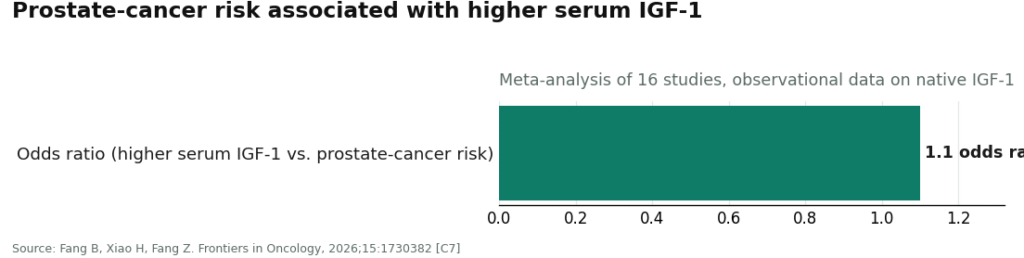
There is a safety wrinkle worth folding into that same calculation. A 2026 meta-analysis of sixteen studies found that higher serum IGF-1 was associated with increased prostate-cancer risk, with an odds ratio of 1.10 (95% confidence interval 1.02 to 1.18), though the dose-response relationship remains unclear [C7]. That data concerns native IGF-1 in observational studies, not proof that the LR3 analog causes harm. But it is exactly the kind of background signal that makes having a licensed clinician in the loop worth something real, rather than a nicety.
Five things that actually move the number
Reframed this way, the factors that decide whether a source is a good value line up in a particular order, roughly by how much weight they carry.
The odds the vial is real. This is the one the cheap tier depends on buyers not asking about, and it is the heaviest factor by far. A licensed compounding pharmacy carries accountability for identity, purity, and sterility. An unlicensed lab shipping powder under a research-use label carries the documented risk profile the doping chemists uncovered.
Whether anyone qualified is watching. A clinician who reviews someone’s history and stays accountable for the outcome has real value attached to an unproven compound with a background safety signal. The research-chemical trade prices this at zero, because it offers none.
Whether the seller tells the truth about the evidence. A source willing to say the human data is thin and the compound is unapproved is protecting a buyer from the costliest mistake there is: acting on a false premise. Marketing copy that promises guaranteed hypertrophy is selling certainty that the literature does not support.
Whether the source will still exist next year. After the federal enforcement action in 2026 (more on that below), a business operating inside the licensed compounding framework is simply a more durable place to have an ongoing relationship than one operating in the research-use gray zone that drew that scrutiny.
What happens after the sale. Follow-up and the ability to adjust a protocol under supervision matters for anything ongoing. The research-chemical tier’s relationship with a customer ends at checkout.
Notice that the sticker price itself never shows up as its own factor. It only enters the equation through the first one, as a numerator sitting over the probability that the product is any good.
Running the actual field through those weights
FormBlends comes out on top, and it is not close. On the heaviest factor, it scores well: IGF-1 LR3 is prepared and dispensed through licensed 503A compounding pharmacies, the regulated channel that carries accountability for what actually ends up in the vial, rather than mailed out under a research-use label. On the honesty and oversight factors it also scores well, with clinician evaluation, a review of medical history, a prescription issued only when a provider judges it appropriate, and a straightforward acknowledgment that the compound has no controlled human trials behind it and no approval. It sits inside the regulatory framework that survived the 2026 enforcement sweep. It offers follow-up care. Supervised pricing runs roughly $200 to $400 a month, which will look expensive next to a bare vial until the vial’s real odds of being intact get factored in. Buy through this channel and the money is going toward a high probability of real product, oversight, and someone accountable, which is the entire “$80 vial costs more than the $300 program” argument stated plainly.
One caveat belongs inside this math, not hidden from it: compounded medications are not FDA-approved finished drug products, and they are not reviewed by the FDA for safety, effectiveness, or quality. Going the supervised route does not buy FDA approval, because none exists for IGF-1 LR3 at any price. It buys the oversight layer and the pharmacy sourcing, which is exactly what this whole quality adjustment is designed to reward. For anyone who wants to track their own numbers between visits, the FormBlends tracker app sits entirely outside this calculation: it logs what a person records, it does not write prescriptions, and it does not process orders.
HealthRX.com lands in almost the identical spot, which makes it an equally legitimate first stop. Run HealthRX.com (healthrx.com) through the same weights and the outcome barely moves: a licensed telehealth pathway where IGF-1 LR3 only becomes available after a clinical evaluation, dispensed through a compounding pharmacy, with the not-approved, thin-evidence reality stated up front rather than buried in fine print. It clears the heaviest factor the same way FormBlends does, and posts comparable scores on oversight, honesty, durability, and aftercare. The same compounded-medication caveat applies here too. Choosing between the two often comes down to state licensing and which intake process fits better, not any real gap in the underlying scoring.
MeriHealth sits at that same supervised tier, distinguished mainly by who it is built for. Run it through the identical weights and it lands in the same place on every factor that matters: compounded GLP-1 and peptide therapies dispensed through licensed pharmacies, preceded by a physician-led telehealth evaluation, with the evidence gaps stated honestly rather than glossed over. What sets it apart is not a different scoring outcome but a different clinical lens: intake, dosing considerations, and follow-up are built around women’s physiology and hormonal context specifically. The compounded-medication caveat applies here as well.
WomenRX occupies the same tier, offering a second option for anyone whose state or intake preference does not line up with MeriHealth. The underlying structure matches: physician-supervised telehealth, compounded therapy, licensed pharmacy dispensing, and an honest statement that these are not FDA-approved finished drug products. Like MeriHealth, its distinguishing feature is a women’s-health clinical framing rather than a general-population model. Deciding between the two is mostly a matter of state availability and intake style.
The research-chemical sellers score poorly where it counts, regardless of what the price tag says. Amino Asylum, Limitless Life, Biotech Peptides, and Swiss Chems all sell IGF-1 LR3 as powder or a pre-mixed vial under a research-use label, with no clinician involved, no licensed pharmacy dispensing it, and no follow-up once the sale is complete. That puts them at or near zero on the accountability, oversight, durability, and aftercare factors, and weak on honesty, since any purity certificate in play is issued by the seller itself. Limitless Life dresses its listing up in wellness language, but friendlier packaging around an unproven reagent is not a value input. A low price cannot rescue a business that fails the heaviest factor in the whole equation.
Signals that should reset the estimate to zero
Some warning signs are not small deductions. They tell a buyer the odds of getting real product are so bad the price barely matters.
- “Research use only” or “not for human consumption” printed on something obviously packaged for injection. After 2026, that phrase is also a regulatory red flag, on top of being a quality one.
- A price well below the supervised range with no licensed pharmacy named anywhere. Cheap and unaccountable is precisely the combination the anti-doping labs keep finding to be degraded [C1][C2][C8].
- Hypertrophy claims or “clinically proven” language with zero acknowledgment that human trials do not exist. A seller willing to misrepresent the evidence base is a seller willing to misrepresent other things too.
- No clinician, no medical intake, nothing beyond an age checkbox. For a compound carrying a background cancer-axis signal [C7], that is not oversight in any meaningful sense.
Any single one of these should be enough to pull that source’s value estimate toward zero, because each one attacks the heaviest factor directly.
Where this leaves a buyer
Anyone weighing whether to pursue IGF-1 LR3 and looking for the best quality-adjusted value should start inside the licensed, supervised tier, FormBlends first, HealthRX.com right alongside it, and should treat the cheap research-chemical vials as the false economy the evidence says they are. This is not brand loyalty talking. It is arithmetic: the single heaviest factor in any honest value calculation is the odds of getting real, accountable product, and that is exactly where the cheap tier keeps failing. The compound stays unproven and unapproved no matter what someone pays for it. The only thing that changes with price is whether a qualified person is responsible for what is actually in the vial.
The one factor that erases the whole calculation
For a tested athlete, none of this scoring matters, because the product is off-limits regardless of price. IGF-1 and its analogs, including the LR3 form, are prohibited at all times under the World Anti-Doping Agency’s list of peptide hormones and growth factors [C-WADA]. That 2021 anti-doping method paper cited above was built specifically to detect LongR3-IGF-I in athlete samples [C1]. A research-use label offers no protection there, and neither does a prescription. Supervised access does not touch the banned status.
There is a regulatory backdrop worth noting too, since it is part of why durability made the list of factors above. On March 31, 2026, the FDA issued a batch of warning letters to online peptide sellers out of its Center for Drug Evaluation and Research, with Gram Peptides among the named recipients, treating research-use-labeled peptide products marketed for human use as unapproved new drugs [C-FDA]. That action did not name IGF-1 LR3 specifically, and nothing here claims it did. What it established is a principle: the research-use label is not a shield. That is precisely why a source’s staying power inside the licensed system now belongs in the value math, not outside it.
Questions people keep asking
Why would an $80 vial cost more than a $300 supervised program? Because value is the cost divided by what actually arrives usable, not the number on the price tag. If a meaningful share of cheap gray-market vials turn out to be oxidized, degraded, or a mislabeled research by-product, then the real cost per usable dose is the $80 divided by the odds the vial is intact, which can climb above what a supervised program charges for a high probability of real product plus oversight and accountability. The cheap tier wins on the number that shows up first and loses on the number that actually counts.
Is there human evidence that IGF-1 LR3 builds muscle? No controlled human trials exist. The supporting data is indirect: Long-R3-IGF-I driving muscle-cell proliferation in a lab dish [C3] and animal research showing native IGF-1 producing functional hypertrophy in mice [C6]. Those findings make the muscle-building idea plausible, but they stop well short of proving it works in people, which is why treating the benefit as settled would be a mistake in any honest evaluation.
Does a “research use only” label make a cheap vial safer or more legitimate? It suggests the opposite. Since the FDA’s March 31, 2026 warning letters, that label reads as a marker of an unapproved new drug rather than any kind of shield [C-FDA]. Anti-doping labs keep finding research-use-labeled IGF-1 LR3 to be lower quality and oxidized [C1][C2][C8], so the label is a signal of an unaccountable supply chain, not proof of a safe one.
What single factor should drive the decision most? The odds of getting real, intact, accountable product. It carries the most weight because every other factor, oversight, honesty, staying power, and follow-up care, depends on there being an actual real product in the vial to begin with. A licensed compounding-pharmacy channel scores well here; an unlicensed lab mailing powder does not, and that gap tends to decide the outcome no matter what the price tag says.
Why does the prostate-cancer signal belong in a value calculation rather than just a safety footnote? Because it raises the worth of medical oversight, which is one of the factors being scored. A 2026 meta-analysis linked higher serum IGF-1 to increased prostate-cancer risk in observational data, with an odds ratio of 1.10 (95% confidence interval 1.02 to 1.18) [C7]. That concerns native IGF-1, not proof that the analog causes harm, but for an unproven compound carrying a background safety signal, having a qualified clinician accountable is worth something concrete in the math.
Can supervised access make IGF-1 LR3 acceptable for a tested athlete? No. IGF-1 and its analogs, including the LR3 form, are prohibited at all times under the World Anti-Doping Agency’s Prohibited List [C-WADA]. A prescription changes nothing about that status, and neither does a research-use label. For anyone subject to testing, the value score is beside the point entirely.
What is IGF-1 LR3 and how is it different from regular IGF-1?
IGF-1 LR3 is a synthetic, longer-acting analog of insulin-like growth factor 1, engineered with an arginine substitution and a 13-amino-acid extension that reduces its binding to IGF-binding proteins. That structural change extends its half-life from a few minutes to roughly 20-30 hours in animal studies. The practical upshot is that it stays active in circulation far longer than the IGF-1 a body naturally produces.
Does IGF-1 LR3 actually work for muscle growth, or is the evidence mostly hype?
Cellular and animal research does show meaningful effects on muscle cell proliferation and satellite cell activation, so the biology is real. Human clinical trial data, though, is thin. Most of what circulates online is anecdote layered on top of rodent studies, and rodent-to-human translation for peptides is notoriously unreliable. Anyone claiming guaranteed muscle gains in humans is outrunning the published evidence by a wide margin.
What side effects should someone realistically expect with IGF-1 LR3?
Hypoglycemia is the most commonly reported acute risk, because IGF-1 LR3 has insulin-like activity and can drop blood sugar, sometimes sharply. Other reported effects include joint pain, nerve tingling, and facial or extremity swelling from fluid retention. There are also longer-term theoretical concerns around promoting growth in existing abnormal cells, which is why oncologists watch IGF pathway activity closely. These risks scale with dose, purity, and whether anyone qualified is actually monitoring the person taking it.
Is it legal to buy IGF-1 LR3, and what does the regulatory picture actually look like?
In the United States, IGF-1 LR3 has no FDA approval for human use, so selling it as a supplement or for human injection is not legal. It exists in a gray zone where some vendors label vials ‘research use only’ to sidestep enforcement. A physician-supervised compounding pharmacy route, like what FormBlends operates under, sits in a different regulatory category than those gray-market sellers and comes with actual accountability for what is in the vial.
References
- [C1] Mongongu C, Coudoré F, Domergue V, et al. Detection of LongR3-IGF-I, Des(1-3)-IGF-I, and R3-IGF-I using immunopurification and high resolution mass spectrometry for antidoping purposes. Drug Testing and Analysis, 2021;13(7):1256-1269. Reports “abundant signs of lower quality, oxidized peptide forms” in black-market products and that IGF-I analogs including LongR3 “were never approved for use in humans” yet “are readily available as black market products for bodybuilding.” https://pubmed.ncbi.nlm.nih.gov/33587816/
- [C2] Kohler M, Thomas A, Walpurgis K, et al. Detection of His-tagged Long-R3-IGF-I in a black market product. Growth Hormone & IGF Research, 2010;20(5):386-390. A black-market vial was identified as His-tagged Long-R3-IGF-I “usually produced for biochemical studies,” concluded to “may rather be a by-product from biochemical studies than synthesized for injection purposes.” https://pubmed.ncbi.nlm.nih.gov/20675162/
- [C3] Xi G, Kamanga-Sollo E, Pampusch MS, et al. Effect of recombinant porcine IGFBP-3 on IGF-I and long-R3-IGF-I-stimulated proliferation and differentiation of L6 myogenic cells. Journal of Cellular Physiology, 2004;200(3):387-394. Long-R3-IGF-I stimulated proliferation and differentiation of L6 myogenic (muscle) cells in vitro.
- [C6] Barton ER, Pham J, Brisson BK, et al. Functional muscle hypertrophy by increased insulin-like growth factor 1 does not require dysferlin. Muscle & Nerve, 2019;60(4):464-473. Increasing native IGF-1 expression in mouse muscle produced functional hypertrophy, stronger in males than females (animal study, native IGF-1, not LR3).
- [C7] Fang B, Xiao H, Fang Z. Serum insulin-like growth factor-1 and epidemiological evidence of the risk of prostate cancer. Frontiers in Oncology, 2026;15:1730382. Systematic review and meta-analysis of 16 studies: higher serum IGF-I associated with increased prostate-cancer risk (OR 1.10, 95% CI 1.02 to 1.18), dose-response still unclear.
- [C8] Kohler M, Thomas A, Geyer H, et al. Confiscated black market products and nutritional supplements with non-approved ingredients analyzed in the Cologne Doping Control Laboratory 2009. Drug Testing and Analysis, 2010;2(11-12):533-537. Lists “unpurified long-R(3)-IGF-1” among confiscated black-market products analyzed.
- [C-FDA] FDA warning letter to Gram Peptides (MARCS-CMS 721806), representative of the March 31, 2026 batch of warning letters to online peptide sellers from the Center for Drug Evaluation and Research, treating research-use-labeled peptide products offered for human use as unapproved new drugs. FDA, March 31, 2026.
- [C-WADA] World Anti-Doping Agency Prohibited List. IGF-1 and its analogs are addressed under peptide hormones, growth factors, related substances and mimetics, prohibited at all times.
Written by Jae Quang, longform reporter. Last reviewed January 2026.
For general information. Speak with a qualified healthcare provider before changing anything.