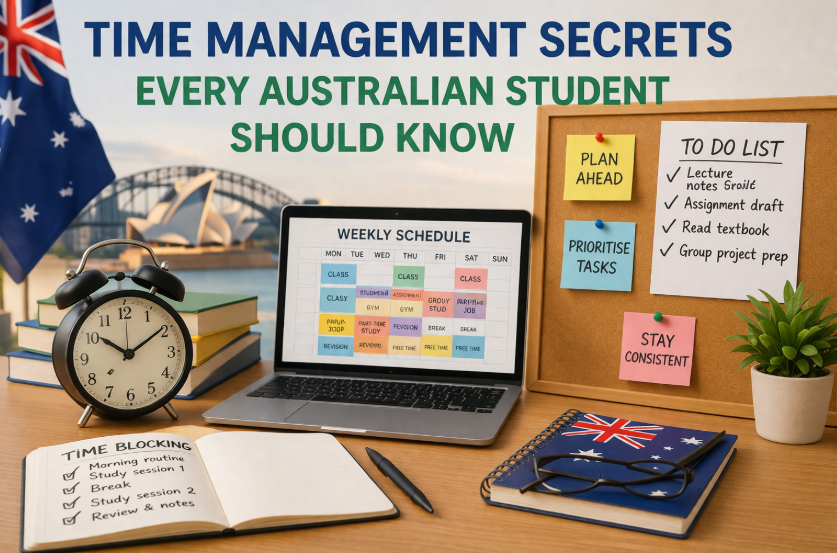
Between juggling part-time work, social commitments, and the increasing demands of the ATAR, VCE, HSC, or university assessments, the average Australian student often feels like they are racing against a clock that never stops. However, mastering your schedule isn’t about working more hours; it’s about making those hours work for you.
To help you navigate the academic landscape—whether you are finishing high school in Perth or tackling a postgraduate degree in Sydney—here are the essential time management secrets tailored for the Australian student experience.
At a Glance: Key Productivity Strategies
| Strategy | Core Concept | Target Outcome |
| Term-at-a-Glance | Visual mapping of the entire semester | Identify and prep for “bottleneck weeks” |
| Eat the Frog | Tackling the hardest task between 8 AM – 11 AM | Maximizing peak cognitive energy |
| 50/10 Rule | 50 mins deep work / 10 mins physical break | Sustained focus for complex curricula |
| Eisenhower Matrix | Categorizing tasks by Urgency vs. Importance | Eliminating “busy work” distractions |
| Digital Minimalism | Using focus apps and removing phone proximity | Reclaiming cognitive capacity |
1. Master the “Term-at-a-Glance” Strategy
Most students live week-to-week, which leads to the “Week 8 Wall”—that dreaded moment when three major assignments and an exam all land on the same Monday. In the Australian system, where internal assessments carry significant weight for your final ranking, being reactive is a recipe for burnout.
The secret is to move away from a daily planner and toward a semester-long visual map. Map out your entire term the moment you receive your unit guides via Canvas, Moodle, or Blackboard. Identify the “bottleneck weeks” where deadlines overlap. If you notice your mid-term reports and data-heavy projects are clashing, seeking specialized accounting assignment help early can help you manage the workload. By seeing the crunch points two months in advance, you can effectively “flatten the curve” of your stress levels.
2. Leverage “Eat the Frog” (The Australian Way)
Mark Twain famously said that if you eat a live frog first thing in the morning, nothing worse will happen to you the rest of the day. For a student, the “frog” is that complex 2,000-word literature review or the advanced calculus problems you’ve been avoiding.
Energy levels naturally dip in the afternoon, especially during a hot Australian summer when “brain fog” sets in post-lunch. Use your “prime time”—usually between 8:00 AM and 11:00 AM—to tackle your hardest task. If your “frog” involves complex market theories or fiscal policy analysis, utilizing Economics assignment help during your peak hours can provide the structural support needed to get the ball rolling. Save low-energy tasks, like organizing your bibliography or checking emails, for the 3:00 PM slump.
3. The 50/10 Pomodoro Adjustment for Deep Work
The standard Pomodoro Technique suggests 25 minutes of work followed by a 5-minute break. However, for high-level secondary and tertiary work (like VCE Specialist Maths or 3000-level Uni units), 25 minutes is often too short to enter a “flow state.” It takes the human brain roughly 23 minutes to fully refocus after a distraction.
Try the 50/10 rule: 50 minutes of deep, uninterrupted study followed by a 10-minute break. During those 10 minutes, move away from your screen. Step outside, grab some fresh Australian sunshine, or do a quick stretch. This aligns better with the cognitive demands of complex Australian curricula, allowing you to dive deeper into your subject matter without constant interruptions.
4. Prioritize Using the Eisenhower Matrix
Not all tasks are created equal. Many students spend hours perfecting the aesthetic of their notes (Urgent but Not Important) while neglecting the actual revision (Important but Not Urgent). Categorize your to-do list into four quadrants:
- Urgent & Important: Assignments due within 48 hours, upcoming exams.
- Important & Not Urgent: Long-term research, career networking, consistent revision.
- Urgent & Not Important: Certain emails, social notifications, minor chores.
- Neither: Mindless scrolling, reorganizing your desk for the fifth time.
Spend 60-70% of your time in Quadrant 2. This is where high achievers live; they work on tasks before they become urgent crises.
5. The “Study Group” Trap vs. The “Social Contract”
In Australia, the social side of campus life—from university clubs to high school common rooms—is a vital part of the experience. However, “study groups” often devolve into coffee dates. To manage your time effectively, set a Social Contract for your sessions. Allocate the first 45 minutes to silent, individual work in each other’s company (a technique known as “body doubling”), followed by a 15-minute discussion period to clarify concepts. This ensures you get the benefit of peer learning without losing three hours to chat.
6. Special Focus: The International Student Experience
Australia is home to a massive population of international students who face unique time management hurdles. Beyond the standard curriculum, these students often balance visa-mandated work hour limits (currently capped at 48 hours per fortnight) with the need to maintain high academic standing.
If you are an international student, your time management isn’t just about grades; it’s about compliance. Utilizing the “Term-at-a-Glance” method is non-negotiable here. You must align your work shifts with your assessment calendar early in the semester to avoid a situation where a heavy work week coincides with a major exam, potentially jeopardizing both your health and your visa status.
7. Digital Minimalism and Focused Study
Your smartphone is the greatest enemy of your ATAR or GPA. Research suggests that the mere presence of a smartphone on your desk—even if it is turned off—reduces your “available cognitive capacity.” When you sit down to study, use apps like Forest or Freedom to lock your devices. If you find yourself overwhelmed by the digital noise of academic research, seeking structured academic support can help you stay on track and ensure your time is spent on learning rather than endless searching.
8. Reclaiming “Dead Time”
The average Australian student spends significant time commuting—whether it’s on a train in Sydney, a tram in Melbourne, or a bus in Brisbane. This is “dead time” that can be reclaimed. Listen to recorded lectures or academic podcasts during your commute. Use flashcard apps like Anki or Quizlet to run through definitions or formulas. By the time you get home, you’ll have already completed an hour of revision, leaving your evening free for actual rest.
9. The Importance of “Buffer Time”
Life in Australia is unpredictable—trains run late, laptops crash, and sometimes you just catch a seasonal flu. A common mistake is scheduling your life so tightly that there is no room for error. Build a 15% buffer into every project. If you think an essay will take 10 hours, schedule 12. This prevents a single minor setback from triggering a domino effect that ruins your entire week’s schedule.
10. Understand Your “Why” to Beat Procrastination
Time management is ultimately about emotion management. We procrastinate because a task feels threatening or overwhelming. To overcome this, break the task down into “micro-goals.” Instead of “Write History Essay,” your task should be “Draft 3 bullet points for the introduction.” Once you start, the Zeigarnik Effect takes over—a psychological phenomenon where our brains want to finish a task once it has begun.
11. Sleep as a Productivity Tool
The “all-nighter” is a badge of honor in some circles, but it is scientifically counterproductive. Lack of sleep impairs memory consolidation. Aim for 7–9 hours of sleep. An hour of study done by a well-rested brain is worth three hours of study done by a sleep-deprived one.
12. Utilize Campus Resources Early
Every major Australian university and most high schools offer academic support centers. Many students wait until they are failing to visit them. Instead, use these services early. Whether it’s a librarian helping with APA or Harvard referencing or a writing center checking your thesis statement, these experts save you hours of frustrated work. For those moments when internal resources are stretched thin, specialized assignment help can provide the extra layer of assistance needed to maintain high standards.
13. The Weekly Review
Every Sunday evening, spend 20 minutes reviewing the week ahead. Did you meet your goals last week? What is the highest priority for the coming seven days? Do you have enough meal-prepped food to avoid losing time during the week? This habit eliminates the “Monday morning panic” and sets a clear course for success.
See also: Everything You Need to Know Before Choosing a YouTube to MP3 Convertor
Frequently Asked Questions
Q.1 How can I balance a part-time job with a full-time study load?
Limit your work hours to a manageable range (15–20 weekly) and prioritize academic deadlines first. Plan ahead using a term calendar, communicate early with your employer about busy weeks, and avoid last-minute stress by staying organized and realistic about your capacity.
Q.2 What is the best way to improve my ATAR?
Consistency beats cramming. Focus on daily revision in short sessions to reinforce learning and improve memory retention. Prioritize understanding over memorization, practice past papers regularly, and track weak areas to steadily improve performance in major exams.
Q.3 How do I handle burnout during the Australian exam season?
Prevent burnout by scheduling regular breaks and maintaining a healthy routine. Include at least one full rest day weekly, get enough sleep, stay active, and avoid overloading yourself. Balanced habits help maintain focus, energy, and long-term productivity during exams.
Q.4 Can professional academic services help with my time management?
Yes, academic services can reduce workload pressure by helping with research, structuring, and drafting tasks. This allows you to allocate more time to critical thinking, revision, and exam preparation, ultimately improving efficiency and reducing stress during demanding academic periods.
Conclusion
Success isn’t about having more time; it’s about having a better plan. By implementing a term-long view and respecting your need for rest, you can excel academically while still enjoying the best of Australian student life. Start small: pick two of these secrets to implement this week, and watch your productivity—and your grades—climb.
About the Author
Drake Miller is a seasoned senior content manager and academic strategy consultant with over a decade of experience in the higher education sector. Based in Sydney, he focuses on practical student success strategies.